

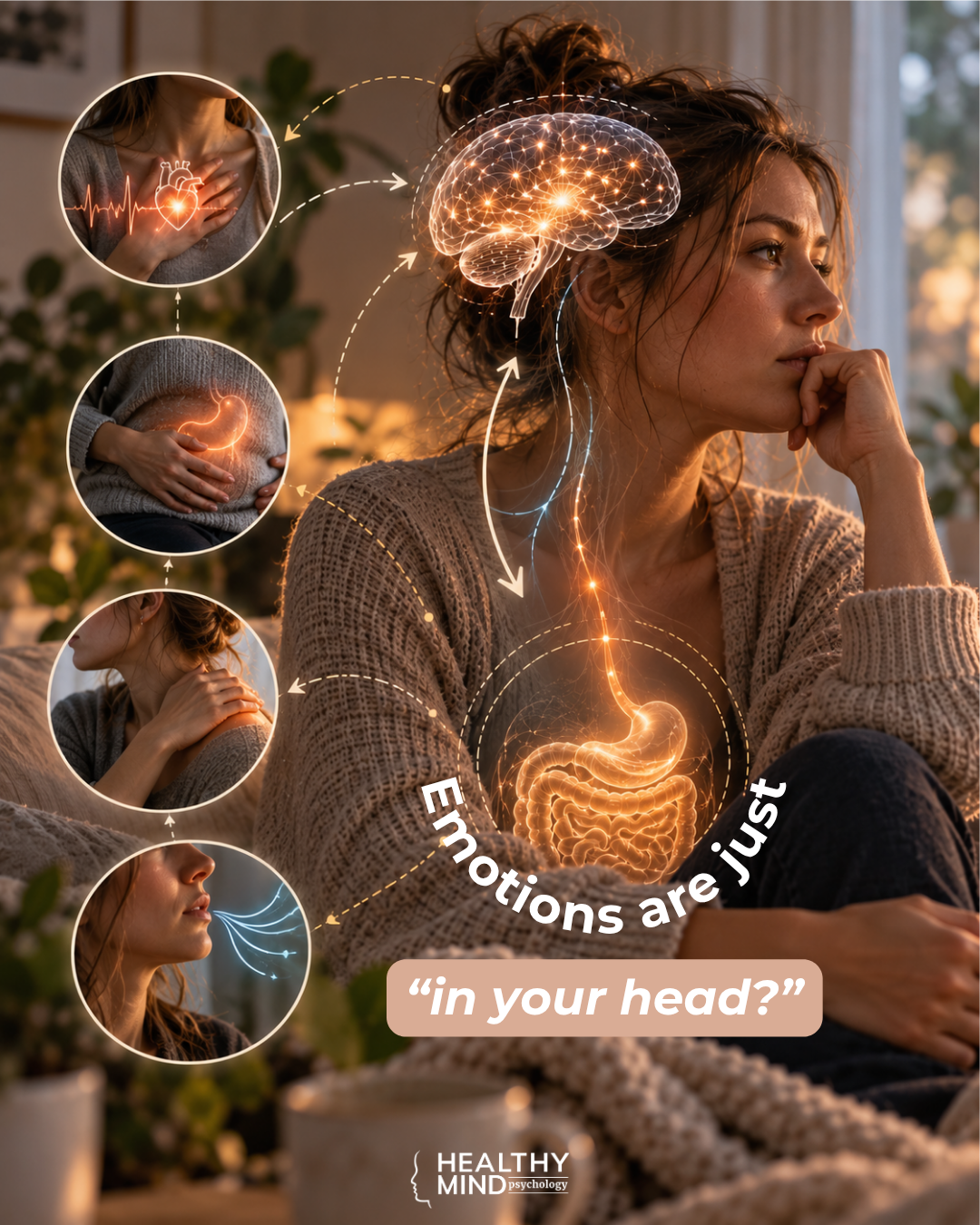
When we talk about emotions, we often talk as though they live somewhere inside our minds.
We think ourselves into feeling anxious. We’re in a bad mood. We need to get something out of our heads.
But think about the last time you felt genuinely nervous about something. Perhaps your heart started beating faster. Your stomach felt unsettled. Your mouth became dry, your shoulders tightened or your breathing changed.
The emotion wasn’t only happening in your thoughts. Your body was right there with you.
One of the fascinating ideas explored by neuroscientist Anil Seth in Being You: A New Science of Consciousness is just how closely our experience of ourselves is connected to our physical bodies. Rather than thinking about the brain as something that sits separately from the body, interpreting the world from its control room, Seth asks us to think about consciousness as something deeply rooted in being a living, biological organism.
And there is a growing body of research exploring just how important communication between brain and body may be for emotion, cognition and our sense of self.
Your brain is listening to your body
We’re very familiar with the senses that tell us about the world outside our bodies: sight, hearing, smell, taste and touch.
But there is another stream of sensory information that receives far less attention.
Your nervous system is continually sensing and integrating information about what is happening inside your body.
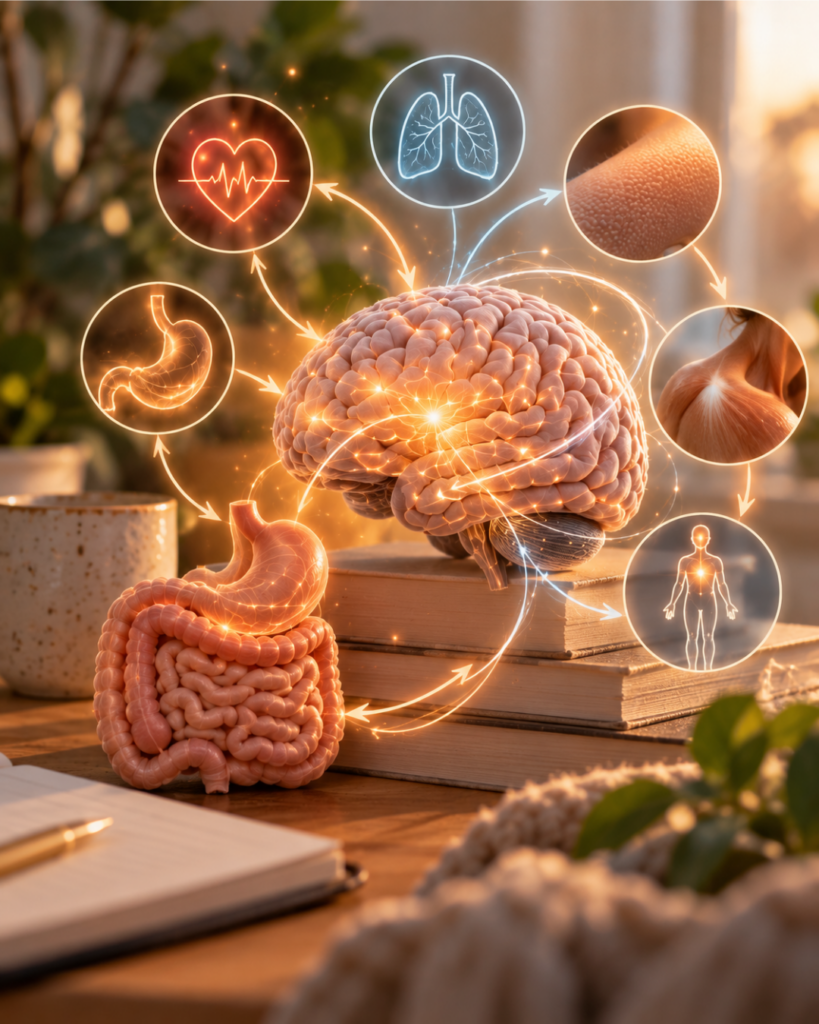
This includes signals associated with your cardiovascular, respiratory, gastrointestinal, thermoregulatory and other bodily systems. Researchers use the term interoception to describe the nervous system’s sensing, interpreting and integration of these internal bodily signals.
Most of this doesn’t require our conscious attention. You probably weren’t particularly aware of your heartbeat a few seconds ago. Now that I’ve mentioned it, perhaps you are.
But these internal signals can contribute to much more than keeping the body’s basic processes running. Research increasingly connects interoception with emotional experience, cognition, self-regulation and our sense of self.
In one influential brain-imaging study, for example, Critchley and colleagues found that activity in the insular cortex was associated with people’s awareness of their own heartbeats, with aspects of this activity also relating to subjective emotional experience.

So does the body create the emotion?
Not quite, and this is where things get more interesting.
A racing heart doesn’t have one fixed emotional meaning.
Imagine your heart beating quickly while you’re standing backstage about to give an important presentation. Now imagine exactly the same physical sensation as you reach the top of a hill after a brisk walk.
The bodily signal may be similar, but your experience of it could be very different.
Context matters.
Modern theories of emotion don’t generally suggest that bodily signals alone straightforwardly determine which emotion we experience. Instead, research considers how bodily information interacts with context, cognition and the brain’s interpretation of what is happening.
This fits particularly well with one of the central ideas explored in Being You: that the brain is a prediction-based system.
Predictive accounts of interoception propose that the brain isn’t simply waiting for bodily information to arrive. It is also generating predictions about the body’s internal state and updating these in response to incoming signals. This framework has been proposed as one way of understanding the relationship between bodily regulation, emotion and our sense of being an embodied self.
Our emotional experiences, then, aren’t simply created by the body, nor are they thoughts generated entirely inside the brain.
They’re part of a much richer conversation between brain, body, environment, expectations and experience.
The same sensation can tell very different stories
This helps us understand why bodily sensations can sometimes feel so powerful.
Take a noticeably fast heartbeat. One person might interpret it as excitement, another might think, Something’s wrong, someone else might barely notice it at all.
Research into interoception distinguishes between the bodily signals themselves and the ways in which we consciously detect, attend to and interpret them. Scientists are still working to understand precisely how these different aspects of interoception relate to emotional experience and mental health.
And once we become concerned about a sensation, our attention may become increasingly focused on it.
You notice your heart beating. You wonder why it’s beating so quickly, you monitor it more closely, and suddenly your heartbeat has become one of the loudest things in the room.
None of this means that the sensation isn’t real. Quite the opposite.
It demonstrates why separating experiences neatly into “physical” or “psychological” can sometimes leave us with an incomplete picture.
Why the mind-body divide can be unhelpful
We still use language that suggests mental and physical experiences belong in separate categories.
But where exactly would we draw the line?
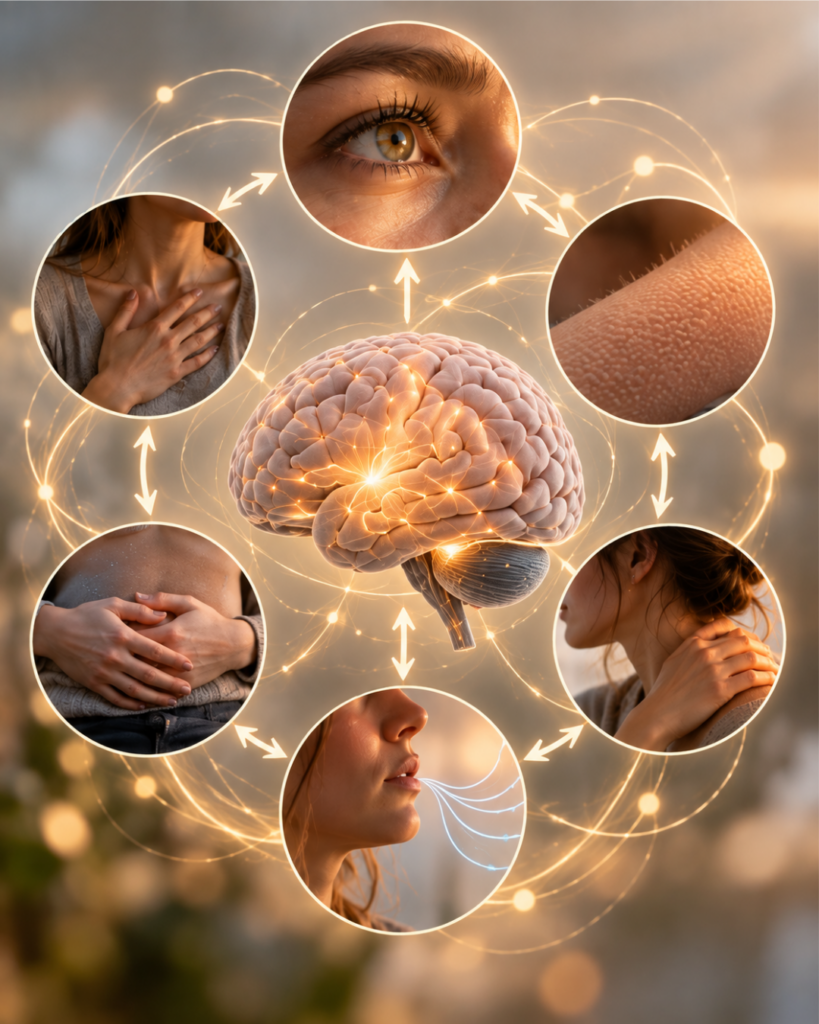
An emotion can involve thoughts, memories and expectations alongside changes in breathing, heart rate, muscle tension, digestion and attention.
Research on interoception increasingly places these bodily signals within our understanding of emotion rather than treating the body as something that merely responds after an emotion has occurred. Reviews of the field describe interoception as contributing not only to physiological regulation, but also to affect, emotion, cognition and self-awareness.
One of the broader themes running through Being You is that we cannot fully understand consciousness without recognising that brains exist within bodies. Seth uses the term “beast machine” to capture this idea: that our experiences of ourselves and the world are fundamentally connected to the biological business of being a living organism.
For psychology, that offers an important reminder. We aren’t brains being carried around by bodies; we are whole systems.
What changes when we look at the whole system?
Understanding emotions in this way isn’t about analysing every heartbeat or trying to find a psychological explanation for every physical sensation.
Nor does recognising brain-body interaction mean physical symptoms should automatically be attributed to emotions or stress. Appropriate medical investigation and care remain important.
Instead, it gives us another way to become curious about our experiences.
If you notice anxiety before an important meeting, for example, you might notice not only the thoughts going through your mind but what is happening elsewhere too.
Has your breathing changed?
Are you holding tension somewhere?
What sensations are you noticing?
What does your brain seem to be predicting is about to happen?
What meaning are you giving those sensations?
Sometimes the most useful question isn’t “Is this physical or psychological?”
It might be:
“What is happening across my whole system right now?”
Because our bodies aren’t simply containers carrying our minds around.
They are part of how we experience ourselves, our emotions and the world around us.
And, as Being You so fascinatingly explores, understanding what it means to be you may require us to pay just as much attention to the body as we do to the brain.
Academic references
- Khalsa, S.S. et al. (2018). Interoception and Mental Health: A Roadmap. Biological Psychiatry: Cognitive Neuroscience and Neuroimaging, 3(6), 501–513.
- Chen, W.G. et al. (2021). The Emerging Science of Interoception: Sensing, Integrating, Interpreting, and Regulating Signals within the Self. Trends in Neurosciences, 44(1), 3–16.
- Quigley, K.S. et al. (2021). Functions of Interoception: From Energy Regulation to Experience of the Self. Trends in Neurosciences, 44(1), 29–38.
- Critchley, H.D. et al. (2004). Neural systems supporting interoceptive awareness. Nature Neuroscience, 7, 189–195.
- Seth, A.K. & Friston, K.J. (2016). Active interoceptive inference and the emotional brain. Philosophical Transactions of the Royal Society B, 371, 20160007.
- Barrett, L.F. & Simmons, W.K. (2015). Interoceptive predictions in the brain. Nature Reviews Neuroscience, 16, 419–429.
If you or someone you know is struggling and would benefit from support, Healthy Mind Psychology is here to help. See our services available here or contact us below.